A good foot cream (containing urea) is more than just a product designed to make the skin feel soft after a pedicure. The right cream supports hydration of the stratum corneum, helps keep the skin supple, and can be an important part of the at-home care recommendations following a pedicure treatment.
That’s why it’s important for pedicurists to consider not only the texture or how a product feels on the skin, but also the ingredients and their effects. For example, what does glycerin do? Why is paraffin used in foot cream? And when should you choose a product with urea? You’ll find the answers in this blog.
Why do feet need extra care?
The skin on the soles of the feet is naturally thicker than the skin on many other parts of the body. In addition, feet are subjected daily to pressure, friction, and occlusion from shoes and socks. When the skin does not retain enough moisture, the stratum corneum can become drier and stiffer. This is also known as xerosis cutis .
Dry skin has a reduced moisture balance in the stratum corneum (the outermost layer of the epidermis) and can therefore feel rough and be more prone to flaking or cracking. Good foot care therefore focuses, among other things, on supporting hydration and the skin barrier.
A foot cream can play an important role here. Applying a suitable cream daily helps keep the skin supple and limits moisture loss from the skin’s surface.
What ingredients make for a good foot cream?
The effectiveness of a foot cream is determined by the combination of various ingredients. A formula often contains both:
- Humectants: attract moisture and help retain it in the stratum corneum. In this way, they support the skin’s hydration. Glycerin and urea are examples of humectants.
- Emollients: soften and smooth the skin by filling the spaces between skin cells in the stratum corneum. This makes the skin feel smoother and can make dry, rough skin more comfortable. Examples include vegetable oils and fatty substances.
- Occlusive ingredients: form a protective layer on the skin, thereby helping to limit moisture loss through evaporation. This keeps moisture in the stratum corneum longer. Paraffinum Liquidum and dimethicone are examples of occlusive ingredients.
In addition, there are a number of other valuable ingredients that contribute to proper foot care:
- Glycerin is a humectant. This means it attracts water and helps retain moisture in the stratum corneum. Glycerin is commonly found in moisturizing skin care products and is also included in both Ginkel’s Foot Cream formulas. This is important for dry feet because proper hydration helps keep the stratum corneum supple.
- Paraffinum Liquidum, also known as mineral oil, is an emollient and also has an occlusive effect. It helps soften the skin and reduces the amount of water that evaporates from the skin’s surface. When combined with humectants such as glycerin, this creates a practical synergy: attracting moisture while simultaneously limiting moisture loss from the skin’s surface.
- Dimethicone is a silicone polymer that forms a thin protective layer on the skin. It is commonly used in products designed to support the skin barrier and make the skin feel smoother.
- Plant-based oils and aromatic ingredients: Ginkel’s Foot Care Cream contains various botanical ingredients and essential oils, including tea tree oil, thyme oil, rosemary oil, lemongrass oil, and lavender oil. Camphor and menthol provide the characteristic refreshing sensation during and after application.
It is important to distinguish between cosmetic properties and medical claims. An ingredient can contribute to a product’s scent, how it feels on the skin, or its skin-care properties without this automatically allowing for a claim of medical efficacy.
Urea in foot cream: why is it so interesting?
For pedicurists, urea in foot cream is an interesting ingredient for treating dry and rough feet. Urea, also known as carbamide, occurs naturally in the skin and is an important component of the Natural Moisturizing Factor (NMF) in the stratum corneum (the outermost layer of the skin). These natural moisture-binding substances help the stratum corneum retain water and contribute to supple, well-hydrated skin.
When the skin is dry, the amount of NMF can decrease. As a result, the stratum corneum retains moisture less effectively, and transepidermal water loss (TEWL) can increase. As a result, the skin becomes drier, rougher, and less supple. Topically applied urea acts as a humectant: it binds water in the stratum corneum, thereby helping to improve skin hydration.
The effect of urea depends in part on its concentration. At lower concentrations—up to about 10%—urea primarily acts as a moisturizer. Recent research on the effects of 10% urea in other foot creams for xerosis shows that this concentration can significantly improve skin hydration. At higher concentrations, the keratolytic effect also increases, allowing urea to help soften thickened and severely calloused skin.
When should you choose a foot cream?
Not every foot has the same care needs. As a pedicurist, you can therefore tailor the product to the condition of the skin.
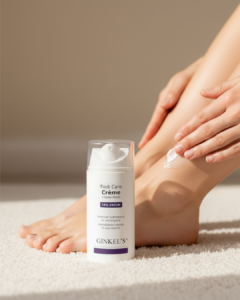
- Ginkel’s Foot Care Cream is suitable for daily foot care. This rich cream combines moisturizing and soothing ingredients with a blend of botanical ingredients, camphor, and menthol. The cream can be applied sparingly 1 to 2 times a day and massaged into clean feet. The cream is also available in a larger 500-ml salon-size container.
- Ginkel’s Foot Care Urea Cream 10% is a logical choice when the skin is noticeably dry and rough and needs more intensive moisturization. The 10% urea supports the moisture balance of the stratum corneum and helps make the skin softer and more supple. The urea foot cream is also available in a larger 500 ml salon-size container.
This way, the difference between the two products can also become part of your professional in-home consultation.
How do you use foot cream for the best results?
A good cream works best when used consistently. Therefore, advise clients to care for their feet daily rather than only when their skin feels dry.
A practical tip:
- Wash your feet and dry them thoroughly.
- Apply a small amount of foot cream .
- Massage the cream in evenly, paying special attention to dry and rough areas.
- Let the cream absorb completely before putting on your socks.
- Repeat this daily as needed, depending on your skin’s needs.
The Ginkel’s Foot Care Cream It is recommended to apply a thin layer of the cream to clean feet 1 to 2 times a day, massaging it in gently. When providing home care advice, also note that the cream does not necessarily need to be applied between the toes. The skin in the spaces between the toes is different from the thicker skin on the soles of the feet, and excessive product can cause unwanted moisture retention there.
Foot cream as part of your pedicure treatment
During a pedicure, you can immediately see what the skin needs. That makes the treatment a great opportunity to provide specific advice on daily foot care. For example, assess the degree of dryness, roughness, and calluses, and choose an appropriate product based on that.
Ginkel’s Foot Care Cream is suitable for the daily care of dry feet. For feet that are especially dry and rough, there is the Ginkel’s Foot Care Cream with 10% Urea. This allows you to tailor your product recommendations to the condition of the skin and your customer’s needs.
Furthermore, specific product recommendations work better when you explain why when you choose a particular cream. For example, briefly discuss which ingredients are beneficial for the skin and how often the customer can use the product at home.
Introduce customers to the cream
Do you want to offer your customers the Ginkel’s Foot Care Cream for themselves first? Then you can take advantage of the samples of the foot cream or miniature foot creams. After the treatment, give the client a sample or miniature and briefly explain what the cream is for and how to use it.
A sample isn’t just a convenient way to introduce the customer to the product; it also gives you an extra opportunity to connect with them. At your next appointment, ask how they liked the cream. This allows you to continue the conversation about at-home skincare and adjust your advice as needed.
For the customer, a sample also makes it easy to try a new foot cream. Experiencing firsthand how the cream feels, absorbs, and nourishes the skin can help them choose a product that fits into their daily routine.